WHY I AM FOR BRO. EDDIE and THE BANGON PILIPINAS TEAM!
When i visited S. Korea for the first time in 2003, i was really humiliated when the immigration officer escorted me to the office and was held for almost an hour. To my surprise, there were 2 Filipinas held for the same "suspicion" that we were going to TNT. After several times they called the local office who requested my trip to go to Amkor Korea for technical support the immigration office released me. The other 2 Pinays were left. Dunno what happened to them. What an experience...
Every time I visit HK to do something in the manufacturing plant of the multinational company i worked before, i always feel that sense of "discrimination" to Pinoys (Pinays). I've been to HK for more than 20 times and still feels the same eerie treatment.... See More
Just this February, i was with 18 foreigners in Chiangmai, Thailand attending a short business as missions course. There was this incident when we were inside the song teow (Thai local jeepney) and I was in front of an internationally known author and speaker and who is an expert in foreign studies and humanities. We were having fun in the song teow and suddenly the topic touched on corruption. And i end up being laughed about by that author when she told me, "didn't the Philippines ranked #2 in Asia in corruption?"... Her laugh was so humiliating and defaming to my pride. I thought about it until we're back in the hotel. I asked myself why should i feel like the way i felt awhile ago in the jeep?... No matter where I go, i have this mark in my forehead that reads "FILIPINO" whenever i am asked by someone or whenever I hand down my passport.
Was I ashamed for the right reasons? Why should I be ashamed? What have i done to contribute to the work to erase this stigma in my forehead that says "FILIPINO: CORRUPT".
Before I went to Thailand, i was not totally convinced about Bro. Eddie. I supported him in 2004. Campaigned and went to Luneta with my kids even. But before 2009 was over, with the many personalities that I thought I admire and were qualified to be President, i thought that this election will be a really complicated one.
There are those who manipulated the death of Cory to their own advantage (Mar Roxas). There were those who stayed with the GMA administration hoping to get the endorsement but lost and went ahead and launched their own campaign (Gordon/Bayani). There were those who already got the upper hand with government money "stashed somewhere" to support their candidacy (Villar et al). There was this candidate who does nothing but to contradict the other one (Jamby). And there was this Bro. Eddie again running. Yes, again!
There were some people also who were disillusioned after the defeat of Bangon in 2004.Some of them to my surprise were relatives of mine. And there were these new groups of people and even Chairman Nur suddenly popped out in the radar supporting Bro. Eddie. Adventist? UCCP? Baptists? Wait a minute. These groups doesn't care about politics. They are just satisfied being holy inside their sanctuaries. What's going on? Where am I going to be?
I had the most serious talk with this American author who now resides in S. Africa about Phil. politics. She was very critical in the beginning. When I asked if she has studied the Philippine political and spiritual background she said no. And she comforted me somehow and said "you've got to pray about it."
I devoured 4 books this past month and a half. Searched the Youtube for videos and the internet for articles.
One thing I stumbled upon was the article written by Chuck Colson titled "The Problem With Ethics". You can search that in the net and you will find the story of Ninoy Aquino mentioned by Chuck Colson. Ninoy was ecstatic to talk to Chuck in the plane to tell Chuck that he (Ninoy) has decided to go back to the Philippines. Chuck asked why? You are crazy... Ninoy said, I have read your book titled "Born Again" while I was inside the jail. I prayed and surrendered my life to Jesus and that made me decide to comeback.
Ninoy was a willing martyr because he found peace in his heart because he knew his calling revealed to him when he surrendered his life to Jesus. His son is running today BUT he did not have the same experience as his father had. That distinguished them both. They are not one and the same Aquino. To assume it would be a death sentence to your vote and to your hopes.
Only a changed man can readily surrender his life whatever the result of his actions be even though there is no clear outcome or solution to the things he has committed himself to. That is unique with Brother Eddie.
Unlike Villar whose confidence in in his vast wealth which doubled more than 13 times after he came into government position or Noynoy whose confidence is the survey made prior to his filing of candidacy or Gibo's confidence of administration machinery to pull the magic in winning.
What have i done to make my this name in my forehead be erased? This is what I am doing now! I AM FOR BRO. EDDIE and the BANGON PILIPINAS Team.
What doctrines/religion separated us, our common cry for pride in national identity and for a government that will not be corrupt has united us together. Look on the bright side. Because if you will not then you might end up in the news next day in the obituary section.
Wednesday, April 21, 2010

Monday, April 19, 2010
The Old Testament Template on Government
Israel's Formation of Government as Model for the Nations
Remember that the truths of the Bible are told primarily in story form. We study the history and context, but we will never be in the same circumstances as Moses and Israel, so their application will not necessarily work for us. The principles, however, are God's truth and are applicable in new and dynamic ways in any age, any set o circumstances in any nation.
Deuteronomy 1:9-18
9At that time I said to you, “I am unable by myself to bear you. 10The Lord your God has multiplied you, so that today you are as numerous as the stars of heaven. 11May the Lord, the God of your ancestors, increase you a thousand times more and bless you, as he has promised you! 12But how can I bear the heavy burden of your disputes all by myself? 13Choose for each of your tribes individuals who are wise, discerning, and reputable to be your leaders.” 14You answered me, “The plan you have proposed is a good one.” 15So I took the leaders of your tribes, wise and reputable individuals, and installed them as leaders over you, commanders of thousands, commanders of hundreds, commanders of fifties, commanders of tens, and officials, throughout your tribes. 16I charged your judges at that time: “Give the members of your community a fair hearing, and judge rightly between one person and another, whether citizen or resident alien. 17You must not be partial in judging: hear out the small and the great alike; you shall not be intimidated by anyone, for the judgment is God’s. Any case that is too hard for you, bring to me, and I will hear it.” 18So I charged you at that time with all the things that you should do.
The Purpose of Government: Deuteronomy 1:9-12
One of the foundational principles in this passage is that the primary purpose of government is to serve the population of a nation by providing an objective, trustworthy source of arbitration and justice. The system of government was organized in such a way that it could serve the needs of people both "small and great" alike (v17). God looked at the judicial needs of the people considering that their current system was not adequate for a population as big as approximately 2 million people at that time the instruction was given.
The Authority of Government: Deuteronomy 1:13
Israel was coming out of Egypt from a 300 years of slavery in a form of a "large family" which originally came from the 70 people of Jacob's clan. Most probably they lack the formal education and lived almost in poverty. God chooses a man in Moses and speak with Him directly. Instead of just directing Moses to choose for himself the people to represent the tribes, God instructed them to choose for themselves those who fit the requirement given by God - wise, understanding and respected men. God did not impose His will but instead He gave the people of Israel the right to choose their political leaders. God is preparing Israel in transition towards the future when they will occupy the promise land later on.
Perhaps you are thinking: "But didn't the prophets actually choose the kings? Not exactly. God did use the prophets to point to the leader He thought would serve their best interest. At God's direction they anointed these leaders with oil, prayed and prophesied over them. But we do not see a king in Israel actually crowned king until we hear words like, "All Israel gathered and took so and so as their king." This principle of authority of the people to choose their political leaders is tested in the lie of David.
We have to wonder why God would design government to have its authority in the people. Wouldn't it better for people to just be told by a loving, benevolent God what is best for them? Evidently not. But it appears that the discipleship of a nation, as well as individuals, is tied to the cause-and-effect learning process of experiencing the blessing or cursing that comes automatically from making choices. In other words, it was more important for Israel to make their choice, even if it was not a perfect choice, and to learn from the consequences.
Character Does Matter: Deuteronomy 1:13
God did not leave Israel floundering in a vacuum with their choices of political leaders. He gave them guidelines (v13) focused on character, knowledge, and the leader's reputation.
Representative: Deuteronomy 1:13
Political representation is a biblical principle. ''...from each of the tribes..." means every tribe must be represented. If the purpose of the government is to truly represent the people by arbitrating their disputes and issues of justice, if the authority of government truly comes from the people, then the people have to be truly represented.
Consensus: Deuteronomy 1:14
This short verse reinforced the authority of the people. Israel agreed to be governed in this way. This principle of consensus is so important that Jesus refers to it as a principle of God's kingdom in the New Testament. "Every kingdom divided against itself will be ruined..." The principle is this: a nation with consensus has a more stable government.
The Judicial Branch: Deuteronomy 1:16-18
These verses lay down such powerful principles of justice that every just court system in the world uses them, and every court on earth today would be more just of the principles were thoroughly implemented.
In verse 17, Israel's judicial system was exhorted to judge without partiality. Justice belongs to God, Moses reminded them. As judges, they were not to be afraid of other people, powers, or influences. They were to remember that, s government agents of justice, they stood first and foremost before God. Moses also laid down the last principle of judicial system in this passage. There is to be a process of appeal.
Study Help:
The domain of government reveals: The King of Kings
The primary attribute o God revealed in government: Justice
God governs this domain through: Delegation of authority to the people
Closing Note:
God is calling us to be good citizen as part of the witness of your faith. Political action and interest are not "secular" in the sense that they are not important or the believer. God instituted government, and He gave you and me responsibility for it. We should explain to our children that God gave us this great right and responsibility to be involved in our political life, and we must cherish and safeguard this right.
As believers we are to believe that our involvement makes a difference because it makes a difference to God. We are to teach our children that serving in government is a high calling, and i God has gifted our children in this area then He may call them and favor them. If this is the case, they will have a much higher purpose in their occupation then "just making money". They must know that they serve God and must have the mind of Christ, the power of the Holy Spirit, and the strategic prayer support if their work is to accomplish smething o lasting value for the Kingdom.
To The Government Professional:
If you are a lawyer, judge, police officer, civil servant, soldier, elected official, social worker, or serve in the government in any capacity, you have a high calling from God. First, you must be just in your dealings with people; then you must work to make the institutions, systems, and laws just. What would our nation look like if every Christian professional made this their passion and pursued it with a sense of call?
God will always start with one. Someone willing to take on the mind of Christ in the political arena and apply it in his life and work and then to the institutions.
Source:
The Old Testament Template - Rediscovering God's Principles for Discipling the Nations by Landa Cope / Template Institute copyright @2006 ISBN: 10-2-8399-0124-2 http://www.templateinstitute.com
Sunday, April 18, 2010
Continuation of Hacienda Luisita Issue

Part 2: Cory’s land reform legacy to test Noynoy’s political will
There is a haunting resemblance between Senator Aquino’s “Hindi Ka Nag-Iisa" music video and a real-life torchlit march of Hacienda Luisita’s workers days before the November 16, 2004 massacre. What could be worth all the blood that has been spilled? The answer lies in a contentious 30-year stock distribution scheme, a legacy from former President Aquino.

Part 3: How a worker's strike became the Luisita massacre
As Sen. Noynoy Aquino campaigns for the presidency, new attention has been focused on events of five years ago when labor strife on his family's sugar estate left seven dead. This is the third of a series that examines the tortured history of Hacienda Luisita, an issue that would face another Aquino administration.

Part 4: After Luisita massacre, more killings linked to protest
After the massacre of 2004, eight more people who were either leaders or supporters of the Luisita strike were murdered in Tarlac. A GMANews.TV investigation reveals that a survivor of one shooting testified in 2005 that Sen. Noynoy Aquino had appealed to him about a "superhighway", which turned out to be the now controversial SCTex.
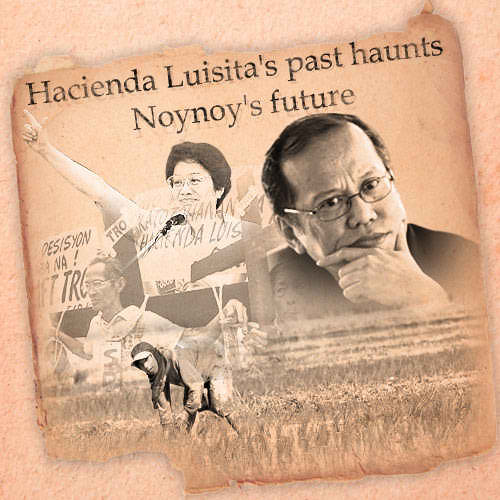
Hacienda Luisita's past haunts Noynoy's future
Hacienda Luisita's past haunts Noynoy's future
By STEPHANIE DYCHIU
This week the country commemorates the tragic shooting of protesting farmers on January 22, 1987, an incident better known as the Mendiola massacre. Along with the Hacienda Luisita massacre of November 16, 2004, these two incidents represent the darker side of the Aquino legacy.
The struggle between farmers and landowners of Hacienda Luisita is now being seen as the first real test of character of presidential candidate Noynoy Cojuangco Aquino, whose family has owned the land since 1958. Our research shows that the problem began when government lenders obliged the Cojuangcos to distribute the land to small farmers by1967, a deadline that came and went. Pressure for land reform on Luisita since then reached a bloody head in 2004 when seven protesters were killed near the gate of the sugar mill in what is now known as the Luisita massacre. This is the story of the hacienda and its farmers, an issue that is likely to haunt Aquino as he travels the campaign trail for the May 2010 elections. Below is part one. Part two is here, part three here and part four here.
First of a series
Senator Noynoy Cojuangco Aquino has said he only owns 1% of Hacienda Luisita. Why is he being dragged into the hacienda’s issues?
This is one of the most common questions asked in the 2010 elections.
To find the answer, GMANews.TV traveled to Tarlac and spoke to Luisita’s farm workers and union leaders. A separate interview and review of court documents was then conducted with the lawyers representing the workers’ union in court. GMANews.TV also examined the Cojuangcos’ court defense and past media and legislative records on the Luisita issue.
The investigation yielded illuminating insights into Senator Noynoy Aquino’s involvement in Hacienda Luisita that have not been openly discussed since his presidential bid. Details are gradually explored in this series of special reports.
A background on the troubled history of Hacienda Luisita is essential to understanding why the issue is forever haunting Senator Noynoy Aquino and his family.
Remnant of colonialism
Before the Cojuangco family acquired Hacienda Luisita in the 1950s, it belonged to the Spanish-owned Compaña General de Tabacos de Filipinas (Tabacalera). Tabacalera acquired the land in 1882 from the Spanish crown, which had a self-appointed claim on the lands as the Philippines’ colonial master. Luisita was named after Luisa, the wife of the top official of Tabacalera.
Tobacco used to be the main crop planted in Luisita, but in the 1920s, the Spaniards shifted to sugar. Sugar production had become more profitable because demand was guaranteed by the US quota. In 1927, the Spaniards built the sugar mill Central Azucarera de Tarlac to accompany their sugarcane plantation.
Around the same year, the wealthy Cojuangco brothers Jose, Juan, Antonio, and Eduardo also put up a small sugar mill in Paniqui, Tarlac. The eldest brother, Jose “Pepe" Cojuangco, Sr., was the father of former President Corazon “Cory" Cojuangco Aquino, and the grandfather of Senator Noynoy Aquino.
Ninoy brokers purchase of Luisita
In 1954, Corazon Cojuangco married Benigno “Ninoy" Aquino, Jr. with President Ramon Magsaysay as one of the ninongs (sponsor) at the wedding. In 1957, Magsaysay talked to Ninoy Aquino about the possibility of Ninoy’s father-in-law, Jose Cojuangco, Sr. acquiring Central Azucarera de Tarlac and Hacienda Luisita from the Spaniards. The Spaniards wanted to sell because of the Huk rebellion and chronic labor problems.
Ninoy Aquino wanted the azucarera and hacienda to stay only within the immediate family of his father-in-law, not to be shared with the other Cojuangcos, wrote American development studies expert James Putzel in his 1992 book A Captive Land: The Politics of Agrarian Reform in the Philippines.
(Dr. James Putzel did extensive research on agrarian reform in the Philippines between the late 1980s to the early 1990s. He is currently a Professor of Development Studies at the London School of Economics.)
The exclusion of Jose Cojuangco, Sr.’s brothers and their heirs from Luisita caused the first major rift in the Cojuangco family, Putzel wrote. This played out years later in the political rivalry of Jose’s son Peping and Eduardo’s son Danding. Today, this divide is seen between Noynoy Aquino (grandson of Jose Sr., nephew of Peping) and Gibo Teodoro (grandson of Eduardo Sr., nephew of Danding), who are both running in the 2010 presidential elections.

Government loans given to Cojuangco
Jose Cojuangco, Sr. received significant preferential treatment and assistance from the government to facilitate his takeover of Hacienda Luisita and Central Azucarera de Tarlac in 1957.
To acquire a controlling interest in Central Azucarera de Tarlac, Cojuangco had to pay the Spaniards in dollars. He turned to the Manufacturer’s Trust Company in New York for a 10-year, $2.1 million loan. Dollars were tightly regulated in those times. To ease the flow of foreign exchange for Cojuangco’s loan, the Central Bank of the Philippines deposited part of the country’s international reserves with the Manufacturer’s Trust Company in New York.

When Spain colonized the Philippines by force beginning 1521, its lands were claimed by the conquistadors in the name of Spain. The natives who were already there tilling the land were put under Spanish landlords, who were given royal grants to “own" the land and exact forced labor and taxes from the natives. After the Spaniards left, the Americans took over. When the Philippines became independent in 1946, history had to be set right by giving the lands back to the people whose ancestors have been tilling them for centuries. However, a new feudal system developed among the Filipinos themselves, and once again drove a wedge between the tillers and their land.
To finance the purchase of Hacienda Luisita, Cojuangco turned to the GSIS (Government Service Insurance System). His application for a P7 million loan said that 4,000 hectares of the hacienda would be made available to bonafide sugar planters, while the balance 2,453 hectares would be distributed to barrio residents who will pay for them on installment.
The GSIS approved a P5.9 million loan, on the condition that Hacienda Luisita would be “subdivided among the tenants who shall pay the cost thereof under reasonable terms and conditions". (GSIS Resolution No. 1085, May 7, 1957; GSIS Resolution No. 3202, November 25, 1957)
Later, Jose Cojuangco, Sr. requested that the phrase be amended to “. . . shall be sold at cost to tenants, should there be any" (GSIS Resolution No. 356, February 5, 1958). This phrase would be cited later on as justification not to distribute the hacienda’s land.
On April 8, 1958, Jose Cojuangco, Sr.’s company, the Tarlac Development Corporation (TADECO), became the new owner of Hacienda Luisita and Central Azucarera de Tarlac. Ninoy Aquino was appointed the hacienda’s first administrator.

In his book, Putzel noted that the Central Bank Monetary Board resolution from 1957 required distribution of Hacienda Luisita’s land to small farmers within 10 years. The controversies that would hound the hacienda for decades can be traced to the Cojuangcos’ efforts to retain control of the land long after the deadline for land distribution passed in 1967.
Land not distributed to farmers
“Ang pagkakaintindi ng mga ninuno naming manggagawang-bukid ng Hacienda Luisita noon, within 10 years, babayaran na [ng mga Cojuangco] ang utang nila sa gubyerno. Pagdating ng 1967, ang lupa ay sa magsasaka na (The way our elders, the farm workers of Hacienda Luisita, understood things at that time, within 10 years, the Cojuangcos were going to pay back the money they borrowed from the government. By 1967, the land would belong to the farmers)," says Lito Bais, one of the present-day leaders of the United Luisita Workers Union (ULWU). Bais was born on the hacienda in 1957, the year before the Cojuangco family took over. His mother was also born on the hacienda.
When 1967 came and went with no land distribution taking place, the farm workers began to organize themselves to uphold their cause. That year, Ninoy Aquino also became the Philippines’ youngest senator. His entry into national politics marked the start of his bitter rivalry with President Ferdinand Marcos.
After Marcos declared Martial Law in 1972, his most voluble critic Aquino, who was planning to run for President, was one of the first people arrested.
Government files case vs. Cojuangcos
The Cojuangcos’ disputed hold over Hacienda Luisita had been tolerated by Marcos even at the height of his dictatorship. However, as Ninoy Aquino and his family were leaving for exile in the US, a case was filed on May 7, 1980 by the Marcos government against the Cojuangco company TADECO for the surrender of Hacienda Luisita to the Ministry of Agrarian Reform, so land could be distributed to the farmers at cost, in accordance with the terms of the government loans given in 1957-1958 to the late Jose Cojuangco, Sr., who died in 1976. (Republic of the Philippines vs. TADECO, Civil Case No. 131654, Manila Regional Trial Court, Branch XLIII)
The Marcos government filed this case after written follow-ups sent to the Cojuangcos over a period of eleven years did not result in land distribution. (The Cojuangcos always replied that the loan terms were unenforceable because there were no tenants on the hacienda.) The government’s first follow-up letter was written by Conrado Estrella of the Land Authority on March 2, 1967. Another letter was written by Central Bank Governor Gregorio Licaros on May 5, 1977. Another letter was written by Agrarian Reform Deputy Minister Ernesto Valdez on May 23, 1978.

The government’s lawsuit was portrayed by the anti-Marcos bloc as an act of harassment against Ninoy Aquino’s family. Inside Hacienda Luisita, however, the farmers thought the wheels of justice were finally turning and land distribution was coming.
Cojuangcos claim hacienda has no tenants
In their January 10, 1981 response to the government’s complaint, the Cojuangcos again said that the Central Bank and GSIS resolutions were unenforceable because there were no tenants on Hacienda Luisita.
“Inilaban ni Doña Metring, yung nanay nila Cory, na wala raw silang inabutan na tao [sa hacienda], kaya wala raw benipesyaryo, kaya ang lupang ito ay sa kanila (Doña Metring, the mother of Cory, said there were no tenants in the hacienda when they took over, therefore there were no beneficiaries, therefore the land belonged to them)," recalls Bais. “E, tignan mo naman ang lupang ito. Paano mapapatag ang lupang ito? Paano makapag-tanim kung walang taong inabutan? (But look at this land. How else could this land have been tamed? How could it have been cultivated if there were no people here when they took over?)"
(The distinction between a tenant farmer and seasonal farmers hired from outside was key to the Cojuangcos’ defense. A tenant farmer is one who is in possession of the land being tilled. In his book A Captive Land, James Putzel noted that the Central Bank resolution mentioned distribution not to tenants but to “small farmers." Raising the issue of tenancy thus seemed ineffective in the defense.)
The Cojuangcos also said in their January 10, 1981 response that there was no agrarian unrest in Luisita, and existing Marcos land reform legislation exempted sugar lands. Further, they asserted that the government’s claim on Luisita had already expired since no litigation was undertaken since 1967.
Court orders Cojuangcos to surrender Luisita
In the meantime, vague rumors of a planned conversion of the hacienda into a residential subdivision or airport, or both, cropped up among the farm workers, causing anxiety that they would be left with no land to till. (This was likely due to the decline of the sugar industry in the Philippines after the US quota ended in the 1970s. Conversion became a buzzword among big landowners all over the country. The Cojuangcos formed Luisita Realty Corporation in 1977 as a first step to turning the hacienda into a residential and industrial complex.)
The government pursued its case against the Cojuangcos, and by December 2, 1985, the Manila Regional Trial Court ordered TADECO to surrender Hacienda Luisita to the Ministry of Agrarian Reform. According to Putzel, this decision was rendered with unusual speed and was decried by the Cojuangcos as another act of harassment, because Cory Aquino, now a widow after the assassination of Ninoy Aquino in 1983, was set to run for President against Marcos in the February 7, 1986 snap elections. The Cojuangcos elevated the case to the Court of Appeals (Court of Appeals G.R. 08634).
Cory promises to give “land to the tiller"
Cory Aquino officially announced her candidacy on December 3, 1985. Land reform was one of the pillars of her campaign.
A farmer GMANews.TV spoke to said they were told by Cojuangco family members managing the hacienda during this time that if Cory became president, Hacienda Luisita would once and for all be distributed to the farmers through her land reform program. He said this promise was made to motivate them to vote for Cory and join the jeepney-loads of people being sent to Manila from Tarlac to attend her rallies.
On January 6, 1986, Aquino delivered the first policy speech of her campaign in Makati and said, “We are determined to implement a genuine land reform program . . . to enable [beneficiaries] to become self-reliant and prosperous farmers."
Ten days later, on January 16, 1986, Aquino delivered her second major speech in Davao and said, “Land-to-the-tiller must become a reality, instead of an empty slogan."
In the same speech, Aquino also said, “You will probably ask me: Will I also apply it to my family’s Hacienda Luisita? My answer is yes."
This campaign promise would haunt her for many years to come. To this day, it haunts her son.
Marcos flees, Aquino dissolves Constitution
The snap elections took place on February 7, 1986. Marcos was declared winner, but was ousted by the People Power revolution. Cory Aquino was sworn in as President on February 25, 1986. She named her running mate Salvador “Doy" Laurel Prime Minister through Presidential Proclamation No. 1.
A month later, Aquino issued Presidential Proclamation No. 3 declaring a revolutionary government and dissolving the 1973 Constitution. This nullified Laurel’s position as Prime Minister, and abolished the Batasang Pambansa (Parliament). Aquino announced that a new Constitution was going to be formed. Legislative powers were to reside with the President until elections were held.
To critics, Aquino’s abandonment of Laurel and her taking of legislative power were early signs that a web of advisers was influencing her decisions. The sway of these advisers would be felt later in the choices Aquino would make regarding Hacienda Luisita.
Juan Ponce Enrile’s link to Hacienda Luisita
On September 16, 1987, Laurel formally broke ties with Aquino. The New York Times reported that Laurel had confronted Aquino about her promise in 1985 to let him run the government as Prime Minister after Marcos was ousted, because she had no experience. This was the reason Laurel agreed to shelve his own plan to run for President and put his party’s resources behind Aquino during the snap elections. “I believed you," the New York Times quoted Laurel saying he told Mrs. Aquino. Aquino just listened without response, Laurel said.
Laurel found an ally in Juan Ponce Enrile, another disenchanted EDSA veteran who now opposed Aquino.
Enrile also happened to be the lawyer of Tabacalera when Hacienda Luisita was taken over by the Cojuangcos in 1957. He was retained by the Cojuangcos after the sale. Enrile’s inside knowledge of the controversial transaction would be a big thorn in the side of the Cojuangco-Aquinos.
Mendiola, a portent of the Luisita massacre
On January 22, 1987, eleven months into the Aquino administration, the Mendiola massacre happened. Thousands of frustrated farmers marched to Malacañang demanding fulfillment of the promises made regarding land reform during the Aquino campaign, and distribution of lands at no cost to beneficiaries. At least a dozen protesters were killed in the violent dispersal. More were seriously injured.
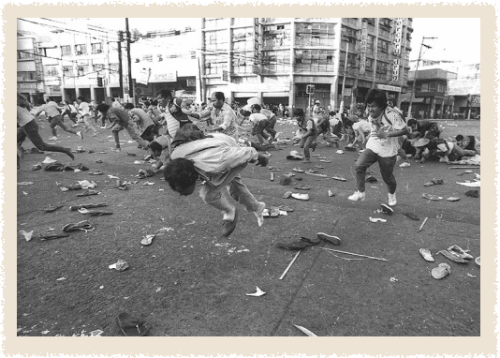
Under pressure after the bloodshed in Mendiola, Aquino fast-tracked the passage of the land reform law. The new 1987 Constitution took effect on February 11, 1987, and on July 22, 1987, Aquino issued Presidential Proclamation 131 and Executive Order No. 229 outlining her land reform program. She expanded its coverage to include sugar and coconut lands.
Her outline also included a provision for the Stock Distribution Option (SDO), a mode of complying with the land reform law that did not require actual transfer of land to the tiller.
(Aquino’s July 22, 1987 “midnight decree", as Juan Ponce Enrile called it back then, raised eyebrows because it was issued just days before the legislative powers Aquino took in 1986 were going to revert back to Congress on July 28, 1987, the first regular session of the new Congress after the May 1987 elections. The timing insured the passage of the SDO.)

Why is land reform a big issue in the Philippines?
Land reform is linked to social justice. When Spain colonized the Philippines by force beginning 1521, its lands were claimed by the conquistadors in the name of Spain. The natives who were already there tilling the land were put under Spanish landlords, who were given royal grants to “own" the land and exact forced labor and taxes from the natives. After the Spaniards left, the Americans took over. When the Philippines became independent in 1946, history had to be set right by giving the lands back to the people whose ancestors have been tilling them for centuries. However, a new feudal system developed among the Filipinos themselves, and once again drove a wedge between the tillers and their land.
What is the SDO (Stock Distribution Option)?
The Stock Distribution Option (SDO) was a clause in the 1988 Comprehensive Agrarian Reform Program (CARP) that allowed landowners to give farmers shares of stock in a corporation instead of land. The landlords then arranged to own majority share in the corporations, to stay in control. This went against the spirit of land reform, which is to give “land to the tiller". The SDO was abolished in the updated land reform law CARPER (CARP with Extensions and Revisions) that was passed in August 2009.
Land reform is linked to social justice. When Spain colonized the Philippines by force beginning 1521, its lands were claimed by the conquistadors in the name of Spain. The natives who were already there tilling the land were put under Spanish landlords, who were given royal grants to “own" the land and exact forced labor and taxes from the natives. After the Spaniards left, the Americans took over. When the Philippines became independent in 1946, history had to be set right by giving the lands back to the people whose ancestors have been tilling them for centuries. However, a new feudal system developed among the Filipinos themselves, and once again drove a wedge between the tillers and their land.
What is the SDO (Stock Distribution Option)?
The Stock Distribution Option (SDO) was a clause in the 1988 Comprehensive Agrarian Reform Program (CARP) that allowed landowners to give farmers shares of stock in a corporation instead of land. The landlords then arranged to own majority share in the corporations, to stay in control. This went against the spirit of land reform, which is to give “land to the tiller". The SDO was abolished in the updated land reform law CARPER (CARP with Extensions and Revisions) that was passed in August 2009.
On May 18, 1988, the Court of Appeals dismissed the case filed in 1980 by the Philippine government—under Marcos—against the Cojuangco company TADECO to compel the handover of Hacienda Luisita. It was the Philippine government itself—under Aquino—that filed the motion to dismiss its own case against TADECO, saying the lands of Hacienda Luisita were going to be distributed anyway through the new agrarian reform law.
The Department of Agrarian Reform and the GSIS, now headed by Aquino appointees Philip Juico and Feliciano “Sonny" Belmonte respectively, posed no objection to the motion to dismiss the case. The motion to dismiss was filed by Solicitor General Frank Chavez, also an Aquino appointee. The Central Bank, headed by Marcos appointee Jose B. Fernandez, said it would have no objection if, as determined by the Department of Agrarian Reform, the distribution of Hacienda Luisita to small farmers would be achieved under the comprehensive agrarian reform program.
Stage is set for “SDO"
A month after the case was dismissed, on June 10, 1988, Aquino signed the Comprehensive Agrarian Reform Law. Soon after, Hacienda Luisita was put under the Stock Distribution Option (SDO) that Aquino included in the law. Through the SDO, landlords could comply with the land reform law without giving land to farmers.
On June 8, 1989, Juan Ponce Enrile, now Minority Floor Leader at the Senate, delivered a privilege speech questioning Aquino’s insertion of the SDO in her outline for the land reform law, and the power she gave herself through Executive Order No. 229 to preside over the Presidential Agrarian Reform Council (PARC), the body that would approve stock distribution programs, including the one for Hacienda Luisita.
Enrile also questioned the Aquino administration’s withdrawal of the government’s case compelling land distribution of Hacienda Luisita to farmers. All these, Enrile said, were indications that the Cojuangcos had taken advantage of the powers of the presidency to circumvent land reform and stay in control of Hacienda Luisita.
Aquino’s sidestepping of land reform would stoke the embers of conflict in Luisita, climaxing in the November 16, 2004 massacre of workers fifteen years later.
TO BE CONTINUED
Sunday, April 11, 2010
The Lords of Olongapo
Here's what other sites are exposing about Gordon, please read on...
When the City of Olongapo is mentioned, the first things that would come to mind are two: the entertainment bars lining its streets and the name Gordon.
While the roots of existence of the former are well-traced, the existence and the reason why the latter became a household name is not much talked about. Who really are the Gordons? How did they come into power? And how for several decades, did a single family dominate the entire political landscape of the city?
The Early Gordon
Though nobody from the local opposition could prove their claim that Olongapo strongman Richard Gordon, the considered head of Olongapo’s first family, is not a Filipino citizen, nobody could dispute that Dick is of an American descent.
The first Gordon to land on Philippine soil was Dick’s grandfather, John Jacob Gordon. John arrived as early as 1898 as part of Admiral George Dewey’s fleet during the Spanish-American War. It was reported that John had Russian Jewish parents, which probably explains his grandson Dick’s behavioral tendencies.
When the war ended, then US President Theodore Roosevelt declared Subic as an American military reservation.
John stayed behind, acquired vast farmlands in Subic, and opened his first bar and restaurant in the area. Outliving his first Filipina wife, he remarried another Filipina by the name of Veronica Tagle, a daughter of a revolutionary known to have served under Gen. Emilio Aguinaldo.
From this second marriage he sired a son with a name similar to the famous Batman cartoon character, James Gordon.
The Rise of a Dynasty
While John Gordon’s other children from his first marriage decided to live comfortably in the states, son James had his stakes, both economically and politically, set on Subic.
He expanded his father’s businesses, and within a short span of time, was able to acquire a hotel, a movie theater, a radio station, a bakeshop, and more restaurants. He married Amelia Juico with whom he had five children, namely Richard (Dick), James Jr. (Bong), Veronica, Cecil and Barbara.
With Filipino blood in his veins, James joined the guerrilla and fought side by side with native Filipinos during the Japanese occupation of the Philippines. When the war ended, he tried his luck in politics and won as councilor of Subic town. At that time, Olongapo was still a barrio of Subic.
In 1959, through constant lobbying and agitation among its citizens, the US government returned some of the reservation areas back to the Philippines and Olongapo became a separate municipality from Subic with James Gordon as its first mayor. Unfortunately, James died even before his term ended. He was assassinated by a lone gunman.
The eldest son Dick was then still too young to take over his father’s place. So to keep their name on politics while waiting for the heir apparent to come of age, his widow Amelia Gordon ran, won, and took the mayoral post.
Dick started his political journey to retake what was “his” in 1971, when he won a seat in the Constitutional Convention. At 26, and still in law school, he was the youngest member of the ConCon.
In 1980, he reclaimed his political inheritance when he won as Olongapo mayor. He then started an all-out campaign to form community organizations. Until now, his efforts continue to prove fruitful for his political interests. Almost all sectors, even the balut vendors down to the dyaryo-bote buyers, all had their share in their sectoral organizations.
After the EDSA revolt, the Aquino administration created a provisionary government and Dick was thrown out of office. That was just temporary however, because he quickly regained his post after winning the succeeding local election.
By then, the political empire of Gordons started to overshadow the entire city. He was then Olongapo mayor, his wife was a member of the House of Representative for Olongapo, and Dick’s younger brother James Jr., was a city councilor.
When the Philippines rejected the extension of the RP-US Bases Treaty, Dick Gordon was appointed chairman of the SBMA while serving as Olongapo mayor. But when pressure from the national government started to mount due to his dual position, he gave up the mayoral post.
In time, his congresswoman wife Kate became City Mayor, his brother James Jr. became the congressman, and nephew JC Delos Reyes (JC is the one running for president under the Kapatiran Party, however, he publicly reiterated his opposition to political dynasties and in fact filed graft cases with the Ombudsman against his own uncle James Jr. who’s now the current Olongapo mayor) became city councilor, and he was SBMA Chairman.
Command and Control
The strategic economic value of the former military base served as a tool to establish political power and subsequently, dominate the surrounding localities, most importantly, the city of Olongapo.
And whoever is in command of the now bustling Freeport practically has the control over the majority of voters who are either a Freeport worker or aspiring to be one. It was one of the reasons why Richard Gordon and the rest of his family lobbied for the establishment and leadership of the SBMA. It’s as simple an analogy as one plus one, to put the entire population within its radius under their command and control.
In fact, during his term at the SBMA, employment opportunities were confined to loyal political wards and supporters. Anybody who wished to oppose or even were contrary to their will simply could not have access to this God-given natural and employment resource.
A simple indicator of this eco-political blackmail during his term was the presentation of a job applicant his voter’s ID complete with precinct number as officially part of the requirements for employment.
When Estrada came to power he appointed Bataan Congressman Felicito Payumo to the SBMA post. The succeeding events that took place during the SBMA leadership conflict made the public realize the “turfdom” that was going on in Subic. (They had a minor glimpse during the APEC Summit, when we were almost killed by an organized mob)
Only then had the residents been given the chance to expose this dominance of the Gordon clan over the entire city. With it went the real situation inside and outside the Freeport, and the true political situation in Olongapo.
Not the First Time
The historic but nevertheless bloody incident that took place in the infamous hostile takeover on Building 229 shocked the entire country, but surprisingly, not the local residents.
According to residents, a similar situation happened right after the first EDSA. Dick Gordon, who was still serving as mayor of Olongapo, refused to step down and give way to the Aquino-appointed Ted Macapagal.
As a result, and pretty much what happened in SBMA, Gordon and his political supporters held vigils within the city hall premises. They stayed there for several days until violence erupted.
After the newly appointed officials successfully took over city government premises, they were surprised to see government properties destroyed. For example, the official vehicle intended for the mayor was filled with human feces much to the dismay of the new staff.
Conclusion
Nepotism had become a common practice. The Gordons have even set-up its own landmarks for all to see. Karilagan Street was renamed Gordon Avenue, Pag-Asa Public Market was renamed James L. Gordon Public Market, Olongapo General Hospital was renamed James L. Gordon Memorial Hospital, a barangay was named Gordon Heights, a bridge was named James L. Gordon Memorial Bridge and a lot more.
These landmarks serve as a stern reminder of who runs and owns the place. A reminder to all, both supporters and otherwise, that non-conformity can lead to an unimaginable risk.
Famous for their numerous slogans, Gordon has a not-so famous one: “Kung ayaw nyo sa patakaran ko, lumayas kayo ng Olongapo!” One can easily surmise who owns what and how much. The idea of Dick Gordon being President certainly makes me shiver.
With all the landmarks renamed, one wouldn’t be surprised if the city council next decides to rename the city after its own centennial rulers. Just as the place bowed in subservience to its ancient Spanish and American conquerors, it is practically destined to bow to the lords of the city.
And with the absence of genuine alternative candidates in the coming election, the dynasty can be sure to survive yet another century.
Source: http://barriosiete.comSaturday, April 10, 2010
Comparison of Wealth and Integrity
Comparison among candidates' wealth:
MANNY VILLAR:
The result of that research came out in this column a couple of weeks ago: documentary evidence—in the form of a death certificate, and a transfer certificate of title, and the senator’s Statement of Assets, Liabilities and Net Worth.
GILBERTO TEODORO:
The networth of GIBO started to increases by the time he became congressman in the 1st district of Tarlac according to govt records of SALN (salary, assets, liabilities & netwrth)http://www.facebook.com/l.php?u=http%3A%2F%2Fwww.youtube.com%2Fwatch%3Fv%3DQ3wYwuujmJk&h=16a4bc240cc675700cea838487761b81
http://www.youtube.com/watch?v=DRWuMK3yei4
Teodoro (member of the House of Representatives 1998-2006, staff in the Office of the President in 2007, and defense secretary from 2008 to 2009) started with a net worth of P80.17 million in 1998, slid to P74.54 million in 2001, grew it to P102.62 million in 2005, and closed it at P232.43 million in 2008 owing to a surge in the value of interest in real estate “inheritance" in Sampaloc, Manila. In 1998, Teodoro reported having “interest in 11 lots" in Sampaloc, Manila.
REAL ASSETS
In 1998, Teodoro declared three real properties: a condominium unit in Makati that he said he purchased for P30 million, a residential house in Makati that he said he built for P10 million, and “interest in 11 lots" in Sampaloc, Manila that he valued at P14 million. His total real assets as of 1998 was P54 million.
Until 2004 or for six years’ running, Teodoro enrolled the same unchanged values for his real assets in his SALNs. But in 2005, he upped the values of the same three real properties thus: Makati condominium, P32.5 million; “interest in real estate" in Sampaloc, Manila, P26 million; Makati residential lot, P25 million, for a total of P83.5 million.
In 2007, his mathematics failed. Teodoro enrolled the total for the value of the same real assets at P100.97 million, even as he reported only the following details: Makati condominium, P32.5 million; interest in real estate in Sampaloc, Manila, P26 million; Makati residential lot, P25 million. (Note: In his 2007 SALN, Teodoro followed the new SALN form, which lists motor vehicles under “Real Properties and Vehicles," thus the higher sum of P100,970, but he did not explain the difference.)
A big surprise came in 2008, when Teodoro suddenly racked up the values of the same three real properties, albeit with still an erroneous total value. He reported this time that his Makati condominum unit was worth P39.98 million; interest in real estate in Sampaloc, Manila, P125.74 million; and the Makati residential lot, still P25 million. Teodoro’s SALN in 2008 reported a total value of the assets at P205.04 million.
CARS, CASH, STOCKS
Teodoro, meanwhile, owned the biggest amount of jewelry, staring with P10 million in 1992 and closing at P11.9 million in 2008.
The value of motor vehicles he owned charted a rise-fall path: from P3 million (same amount from 1998 to 2002), it tripled to P10.35 million in 2004, dipped by half to P4.3 million in 2005, quadrupled to P17.47 million in 2007, and rose further to P19.55 million in 2008.
As strange is the sudden surge in Teodoro’s stocks portfolio since 2007. In 1998, he first declared owning stocks valued at P5.20 million. He enrolled the same amount, to the last centavo, in the next seven years, or until 2005.
In 2007, though, Teodoro’s SALNs enrolled a bigger entry for “stocks (equity paid)" of P11.70 million. The next year, 2008, this grew further to P23.95 million.
The amount increased slightly to P9.9 million in 2002, but dipped sharply to P5.70 million in 2004, and on to P5.36 million in 2005. Curiously, again in 2007, Teodoro’s cash pile doubled to P10.06 million, before sliding back to P8.5 million in 2008.
GIBO and GMA shares the same increases in theior networth together with the congressman sons of GMA by the time they entered politics. (Source: Facebook account of John Lana)
MANNY VILLAR:
The result of that research came out in this column a couple of weeks ago: documentary evidence—in the form of a death certificate, and a transfer certificate of title, and the senator’s Statement of Assets, Liabilities and Net Worth.
The first two documents strongly suggest that, indeed, the Villar family was certainly neither dirt poor nor even poor at all: at the time of his younger brother’s death, his family’s address (information provided by his father) turned out to be a one-and-a-half story house on a 560-sq m lot in the better side of Tondo, or rather Navotas. (My colleague in television, Arnold Clavio, was born and raised in Tondo, and he recalls visiting his “rich” relatives who lived in the same village where the Villars had their home.) It also turns out that little Danny Villar had actually died of leukemia—and even the richest family on earth would not have been able to prevent that death, because at the time (1962) there was no treatment for this illness (there still is none now, although medical advances have been made that would prolong the life of the victim).
The third set of documents shows that Senator Villar’s net worth had increased to more than 13 times its original value from the time he became a congressman in 1992 to 2008, when he was a senator (and became Senate president). Which would strongly suggest that the rise in his fortunes was closely connected to his government service.
The bottom line has to be obvious: Villar’s campaign ads have no basis in truth and in fact. (Source: Solita Monsod - Inquirer article)
GILBERTO TEODORO:
The networth of GIBO started to increases by the time he became congressman in the 1st district of Tarlac according to govt records of SALN (salary, assets, liabilities & netwrth)http://www.facebook.com/l.
http://www.youtube.com/wat
Teodoro (member of the House of Representatives 1998-2006, staff in the Office of the President in 2007, and defense secretary from 2008 to 2009) started with a net worth of P80.17 million in 1998, slid to P74.54 million in 2001, grew it to P102.62 million in 2005, and closed it at P232.43 million in 2008 owing to a surge in the value of interest in real estate “inheritance" in Sampaloc, Manila. In 1998, Teodoro reported having “interest in 11 lots" in Sampaloc, Manila.
REAL ASSETS
In 1998, Teodoro declared three real properties: a condominium unit in Makati that he said he purchased for P30 million, a residential house in Makati that he said he built for P10 million, and “interest in 11 lots" in Sampaloc, Manila that he valued at P14 million. His total real assets as of 1998 was P54 million.
Until 2004 or for six years’ running, Teodoro enrolled the same unchanged values for his real assets in his SALNs. But in 2005, he upped the values of the same three real properties thus: Makati condominium, P32.5 million; “interest in real estate" in Sampaloc, Manila, P26 million; Makati residential lot, P25 million, for a total of P83.5 million.
In 2007, his mathematics failed. Teodoro enrolled the total for the value of the same real assets at P100.97 million, even as he reported only the following details: Makati condominium, P32.5 million; interest in real estate in Sampaloc, Manila, P26 million; Makati residential lot, P25 million. (Note: In his 2007 SALN, Teodoro followed the new SALN form, which lists motor vehicles under “Real Properties and Vehicles," thus the higher sum of P100,970, but he did not explain the difference.)
A big surprise came in 2008, when Teodoro suddenly racked up the values of the same three real properties, albeit with still an erroneous total value. He reported this time that his Makati condominum unit was worth P39.98 million; interest in real estate in Sampaloc, Manila, P125.74 million; and the Makati residential lot, still P25 million. Teodoro’s SALN in 2008 reported a total value of the assets at P205.04 million.
CARS, CASH, STOCKS
Teodoro, meanwhile, owned the biggest amount of jewelry, staring with P10 million in 1992 and closing at P11.9 million in 2008.
The value of motor vehicles he owned charted a rise-fall path: from P3 million (same amount from 1998 to 2002), it tripled to P10.35 million in 2004, dipped by half to P4.3 million in 2005, quadrupled to P17.47 million in 2007, and rose further to P19.55 million in 2008.
As strange is the sudden surge in Teodoro’s stocks portfolio since 2007. In 1998, he first declared owning stocks valued at P5.20 million. He enrolled the same amount, to the last centavo, in the next seven years, or until 2005.
In 2007, though, Teodoro’s SALNs enrolled a bigger entry for “stocks (equity paid)" of P11.70 million. The next year, 2008, this grew further to P23.95 million.
The amount increased slightly to P9.9 million in 2002, but dipped sharply to P5.70 million in 2004, and on to P5.36 million in 2005. Curiously, again in 2007, Teodoro’s cash pile doubled to P10.06 million, before sliding back to P8.5 million in 2008.
GIBO and GMA shares the same increases in theior networth together with the congressman sons of GMA by the time they entered politics. (Source: Facebook account of John Lana)
What's wrong with our country?
We all want to effectuate change in our country starting with ourselves...you all agree with that. If we can only come up with the common point kung saan tayo magsisimula ay mas maiintindihan natin ang sitwasyon ng mabuti at ang isat-isa ng maayos.
The Philippines is known as "the sick man o Asia"... ano ang sakit?
Diagnosis (Cause & Effect Analysis):
- are we sick because we have education problem? NO!
- are we sick because we are not developing? NO!
- are we sick because we have many poor? NO!
- are we sick because we have no environmental plans?NO
then why are sick? Corruption makes us sick
- Corruption drains money suppose to be used for:
- education funding
- development funding
- poverty alleviation programs funding
- jobs creation and national industry funding
- environmental projects funding
Effect: Government does not meet the need of the people. The leadership has no integrity. The leader can't effectuate real change.
Prognosis:
MARCOS' era: His intelligence and competence drowned him with power and power corrupted him, declared Martial Law and cause the military to be the instrument of corruption. The First Family used their influence to get anything.
CORY's era: SOA of Hacienda Luisita signed by Cory made it immuned to the CARP law, Cory protected her interest. Cory also was hard hearted and refused to forgive Marcos even at his death bed. Claimed to be religious but unforgiving. Prayers were not answered because of unforgiveness (Mark 11:22-25). Neglected all the good projects of the previous agministration. Vendictiveness. Resulted to supernatural problems like 5 strongest typhoons recorded in history under Cory's time, Baguio earthquake, 7 coup d'etat, and finally Mount Pinatubo eruption.
RAMOS' era: country already beginning to rise up but many projects caused more debts to the country. But the country almost become a tiger economy but lacked the time to sustain the program after 6 years of term. Successor was not successful in winning the election thus his programs stopped.
ERAP's era: disregarded Ramos' programs and his heavy drinking and gambling caused issues in his personal life and close friends that conspired to bring him down. Couldn't control the power struggle because of his lack of concentration due to heavy drinking and other vices and lack of moral values. Manipulated stocks to his advantage. Promised to do away with nepotism but did the opposite. Used military power to quench the Muslim insurgency for a short period only but did not bring lasting peace really. Spent only 2 years.
GMA's era: conspiracy to power grab is not a good way to leadership. She ended up paying her cohorts with positions that caused them to corruption. Military generals were the top beneficiaries. Very desperate to stay in power so manipulated the elections of 2004 using government funds and the military hierarchy in Mindanao. Now wants to run in Congress to protect herself from future investigations.
Conclusion: LACK OF INTEGRITY CAUSES LEADERS TO COMMIT MISTAKES ESPECIALLY CORRUPTION.
INTEGRITY:
The etymology of the word "integrity" can suggest insight into its use and meaning. It stems from the Latin adjective integer (whole, complete). In this context, integrity may comprise the personal inner sense of "wholeness" deriving from (say) honesty and consistency of character. (Wikipedia)
Ethical meanings of integrity used in medicine and law refer to the wholeness of the human body with respect for "sacred" qualities such as a sense of unity, consistency, purity, unspoiledness and uncorruptedness. (Wikipedia)
The Christian vision of integrity suggests that personal authenticity entails living in accordance with personal convictions that are based on an understanding of God's purposes for creation, humankind and the person as a disciple of Jesus. (Wikipedia)
- Now based on the 8 candidates, WHO DO YOU THINK AND BELIEVE HAS MORE INTEGRITY (the deeper meaning of which is from the Christian view of integrity)?
The Philippines is known as "the sick man o Asia"... ano ang sakit?
Diagnosis (Cause & Effect Analysis):
- are we sick because we have education problem? NO!
- are we sick because we are not developing? NO!
- are we sick because we have many poor? NO!
- are we sick because we have no environmental plans?NO
then why are sick? Corruption makes us sick
- Corruption drains money suppose to be used for:
- education funding
- development funding
- poverty alleviation programs funding
- jobs creation and national industry funding
- environmental projects funding
Effect: Government does not meet the need of the people. The leadership has no integrity. The leader can't effectuate real change.
Prognosis:
MARCOS' era: His intelligence and competence drowned him with power and power corrupted him, declared Martial Law and cause the military to be the instrument of corruption. The First Family used their influence to get anything.
CORY's era: SOA of Hacienda Luisita signed by Cory made it immuned to the CARP law, Cory protected her interest. Cory also was hard hearted and refused to forgive Marcos even at his death bed. Claimed to be religious but unforgiving. Prayers were not answered because of unforgiveness (Mark 11:22-25). Neglected all the good projects of the previous agministration. Vendictiveness. Resulted to supernatural problems like 5 strongest typhoons recorded in history under Cory's time, Baguio earthquake, 7 coup d'etat, and finally Mount Pinatubo eruption.
RAMOS' era: country already beginning to rise up but many projects caused more debts to the country. But the country almost become a tiger economy but lacked the time to sustain the program after 6 years of term. Successor was not successful in winning the election thus his programs stopped.
ERAP's era: disregarded Ramos' programs and his heavy drinking and gambling caused issues in his personal life and close friends that conspired to bring him down. Couldn't control the power struggle because of his lack of concentration due to heavy drinking and other vices and lack of moral values. Manipulated stocks to his advantage. Promised to do away with nepotism but did the opposite. Used military power to quench the Muslim insurgency for a short period only but did not bring lasting peace really. Spent only 2 years.
GMA's era: conspiracy to power grab is not a good way to leadership. She ended up paying her cohorts with positions that caused them to corruption. Military generals were the top beneficiaries. Very desperate to stay in power so manipulated the elections of 2004 using government funds and the military hierarchy in Mindanao. Now wants to run in Congress to protect herself from future investigations.
Conclusion: LACK OF INTEGRITY CAUSES LEADERS TO COMMIT MISTAKES ESPECIALLY CORRUPTION.
INTEGRITY:
The etymology of the word "integrity" can suggest insight into its use and meaning. It stems from the Latin adjective integer (whole, complete). In this context, integrity may comprise the personal inner sense of "wholeness" deriving from (say) honesty and consistency of character. (Wikipedia)
Ethical meanings of integrity used in medicine and law refer to the wholeness of the human body with respect for "sacred" qualities such as a sense of unity, consistency, purity, unspoiledness and uncorruptedness. (Wikipedia)
The Christian vision of integrity suggests that personal authenticity entails living in accordance with personal convictions that are based on an understanding of God's purposes for creation, humankind and the person as a disciple of Jesus. (Wikipedia)
- Now based on the 8 candidates, WHO DO YOU THINK AND BELIEVE HAS MORE INTEGRITY (the deeper meaning of which is from the Christian view of integrity)?
Subscribe to:
Posts (Atom)